The Doctor Strange Pause
I swear to you I did not plan this.
I went to bed early, trying to get some sleep and was stirred by my neighbor playing...let's say offensive music on a level we used to call 10. As I lingered between sleep and getting up to complain, a thought drifted up. Doctor Strange. The movie version of the comic book opens on Friday. The CGI and whatever else they have to throw at us looks interesting and interest from relatives has had me thinking about that character.
He first appeared in the 1960's in Strange Tales comics drawn by Steve Ditko who was the original artist on Spider-Man. His art had an eerie quality about it and it came through on Strange. But the nature of Strange's powers always eluded me. Marvel usually defined the powers of their heroes pretty clearly. Thor and his hammer, Spider-Man with spider sense and strength and web solution. Iron man with his gadgets. Thing and Hulk both smash. Sue Storm invisible and force fields. Human Torch's self-explanatory "Flame On!".

But Strange had no definition of his power. Obviously, from the quote, he wants to be God and isn't, which touches on our continuing theme of men trying to become their creator. He fought with waved hands and a magic amulet and a cloak of levitation. But it was all magic. Some sort of power flowing from an unknown source. the mind. the mystic. the otherworldly.
His power was clearly not his own but was claimed as being his own. Supposedly his mind and will was controlling a power over reality. In the mythology the Marvel films are entering, Strange becomes the guide to the spiritual level of the battle with Thanos.

Both Darkseid and Thanos are Satan wannabes. Both have serious issues with their God-like fathers. Both were among the first modern gods comic creations.
The reason this stands out to me in this moment of the blog is that Strange is the prophet of this mythology, the man in contact with the spiritual center of that comic world, the Moses chosen by a "guru" Ancient One instead of by God to guide super-heroes in a war for the freedom of all humanity.
Except of course Strange is not Moses.
Ex 7:10 Then Moses and Aaron went in to Pharaoh and they did as the Lord had said: and Aaron put his rod down on the earth before Pharaoh and his servants, and it became a snake.
11 Then Pharaoh sent for the wise men and the wonder-workers, and they, the wonder-workers of Egypt, did the same with their secret arts.
12 For every one of them put down his rod on the earth, and they became snakes: but Aaron's rod made a meal of their rods.
(BBE)
Strange would have been one of the Pharaoh's men, creating a magic snake of his own only to have it devoured by the true snake created by God. Because to those magic men the snake was the god and that was their failing and the failing of Strange.
Strange worships the idea of HIS power. In the mutually contradictory nature of new age ideas, Strange must loses himself as the egotistic surgeon but become the self assured mystic. He must see the power of magic as HIS tool to accomplish HIS goals under the selfless mantle of saving humanity. He feels he has to defeat the enemy himself. Whether it be Kaecillus from the movie.
Kaecilius was a sorcerer and a former member of the Masters of the Mystic Arts who became disillusioned with the Ancient One when he felt his mentor was not allowing other dimensions to come to Earth, which he believed could reunite him with his deceased wife and son. He formed the Zealots with the intention of defeating the Ancient One and bringing the inter-dimensional being known as Dormammu to Earth, but was eventually challenged by his former brothers-in-arms as well as a new Master of the Mystic Arts, Doctor Strange. He was defeated and became part of the Dark Dimension for all eternity, gaining him the immortality he had desired.
Or facing various other dimensional threats, Standing for this world against others, his adventures echo of a certain candidate: "Only I can defeat Dormammu."
Stephen Strange is a comic character who is a false prophet who will have disciples and followers and women who love the actor portraying him and will last for a while, a Fallen Flesh legend for this age and time. Unlike the eternal story of Moses.
I swear to you I did not plan this.
I went to bed early, trying to get some sleep and was stirred by my neighbor playing...let's say offensive music on a level we used to call 10. As I lingered between sleep and getting up to complain, a thought drifted up. Doctor Strange. The movie version of the comic book opens on Friday. The CGI and whatever else they have to throw at us looks interesting and interest from relatives has had me thinking about that character.
He first appeared in the 1960's in Strange Tales comics drawn by Steve Ditko who was the original artist on Spider-Man. His art had an eerie quality about it and it came through on Strange. But the nature of Strange's powers always eluded me. Marvel usually defined the powers of their heroes pretty clearly. Thor and his hammer, Spider-Man with spider sense and strength and web solution. Iron man with his gadgets. Thing and Hulk both smash. Sue Storm invisible and force fields. Human Torch's self-explanatory "Flame On!".
 I need more power. I want to be able to move worlds and shake them to their foundations. I want enough power in my hands to tear planets from the heavens and place them in a new sky.
- -- Doctor Strange


But Strange had no definition of his power. Obviously, from the quote, he wants to be God and isn't, which touches on our continuing theme of men trying to become their creator. He fought with waved hands and a magic amulet and a cloak of levitation. But it was all magic. Some sort of power flowing from an unknown source. the mind. the mystic. the otherworldly.
His power was clearly not his own but was claimed as being his own. Supposedly his mind and will was controlling a power over reality. In the mythology the Marvel films are entering, Strange becomes the guide to the spiritual level of the battle with Thanos.
Writer-artist Jim Starlin originally conceived of Thanos of Titan (The moon of Saturn) during college psychology classes. As Starlin described:
Starlin has admitted the character is influenced by Jack Kirby's Darkseid:
Both Darkseid and Thanos are Satan wannabes. Both have serious issues with their God-like fathers. Both were among the first modern gods comic creations.
The reason this stands out to me in this moment of the blog is that Strange is the prophet of this mythology, the man in contact with the spiritual center of that comic world, the Moses chosen by a "guru" Ancient One instead of by God to guide super-heroes in a war for the freedom of all humanity.
Except of course Strange is not Moses.
Ex 7:10 Then Moses and Aaron went in to Pharaoh and they did as the Lord had said: and Aaron put his rod down on the earth before Pharaoh and his servants, and it became a snake.
11 Then Pharaoh sent for the wise men and the wonder-workers, and they, the wonder-workers of Egypt, did the same with their secret arts.
12 For every one of them put down his rod on the earth, and they became snakes: but Aaron's rod made a meal of their rods.
(BBE)
Strange would have been one of the Pharaoh's men, creating a magic snake of his own only to have it devoured by the true snake created by God. Because to those magic men the snake was the god and that was their failing and the failing of Strange.
Strange worships the idea of HIS power. In the mutually contradictory nature of new age ideas, Strange must loses himself as the egotistic surgeon but become the self assured mystic. He must see the power of magic as HIS tool to accomplish HIS goals under the selfless mantle of saving humanity. He feels he has to defeat the enemy himself. Whether it be Kaecillus from the movie.
Kaecilius was a sorcerer and a former member of the Masters of the Mystic Arts who became disillusioned with the Ancient One when he felt his mentor was not allowing other dimensions to come to Earth, which he believed could reunite him with his deceased wife and son. He formed the Zealots with the intention of defeating the Ancient One and bringing the inter-dimensional being known as Dormammu to Earth, but was eventually challenged by his former brothers-in-arms as well as a new Master of the Mystic Arts, Doctor Strange. He was defeated and became part of the Dark Dimension for all eternity, gaining him the immortality he had desired.
Or facing various other dimensional threats, Standing for this world against others, his adventures echo of a certain candidate: "Only I can defeat Dormammu."
Dormammu first appeared in Strange Tales #126–127 (November – December 1964), but had been mentioned previously in dialog, along with his realm the "Dark Dimension".
Writer Mike Conroy said:
(Note: Strange had disciples in the real world. That may have been an exaggeration but it was a good depiction of what Lee wanted to create, another "savior of humanity", this one saving us from mystical enemies. Incidentally, the name Stan is only a letter "a" from Satan. W,)
After being established as the ruler of an alternate dimension (later described as the god-tyrant of its denizens),[3] Dormammu became a perennial foe of Sorcerer Supreme Doctor Strange, who until this time had dealt almost exclusively with off-beat "one-off" mystical threats in Strange Tales #110–125 (July 1963 – October 1964). Strange's first encounter with Dormammu in the "Dark Dimension" also introduced Clea, eventually revealed to be the niece of the villain (like Clea's name, this was not initially revealed in Strange Tales #126; November 1964), and the monstrous and imprisoned Mindless Ones.
Dormammu is first mentioned by Karl Amadeus Mordo, senior apprentice of the appointed "Sorcerer Supreme" the "Ancient One", who, in the entity's service, attempts to slowly weaken the sorcerer, but is stopped when his fellow pupil Stephen Strange alerts his master to the betrayal.[4]
The character later appears in person when sending a messenger to boast his renewed intentions of conquering his universe before his aging adversary. In response, Doctor Strange travels to Dormammu's "Dark Dimension" as the Ancient One does not consider himself powerful enough to defeat Dormammu, and manages to overcome all supernatural servitors sent against him. Dormammu engages Strange in mystic combat and shows himself to be far more powerful, but, when drawing upon the realms energies, inadvertently weakens the barrier containing the horde of Mindless Ones. Since they threatened Dormammu's subjects, Strange helped his enemy to re-seal the juggernauts by letting power from his amulet flow into Dormammu. Indebted to Strange for his help, Dormammu ends the fight, and in return Strange demands a binding vow to never enter the "Earth realm" again and to not harm Clea. Dormammu complies, but gains a burning hatred against Strange for the humiliation.[5]
Dormammu uses a loophole to his oath by granting Mordo vast power, whereupon the sorcerer leads his minions on a lengthy hunt for Strange, and abduct the Ancient One as a bargaining chip. Dormammu's niece, Clea, assists Strange by weakening the barrier of the Mindless Ones, forcing her uncle to focus elsewhere. Dormammu learns of her betrayal, brings all three Earth sorcerers to a neutral realm, to let her see his disciple destroy Strange, and summons fellow "Lords of the Netherworlds" to watch the spectacle. When Strange begins to get an advantage against Mordo, Dormammu decides to face the sorcerer in a contest of pure hand-to-hand-combat. The physically stronger entity eventually falls to his foe's greater familiarity with martial arts. To Dormammu's humiliation, before the gathered Lords, Strange forces him to vow not to menace the Earth even by proxy. The villain strikes a parting blow by banishing Clea, and inciting another lord to attack Strange.[6]
In an apparent bid for power the character engages the universal embodiment, Eternity, in single combat, but is defeated and banished.[7]
Dormammu captures Clea, and overpowers and imprisons Strange. The sorcerer manipulates Umar into freeing him, and then surprises Dormammu by pushing him through a portal to the Earth. This makes the entity wither from the curse cast by his own power, when vowing to never enter the Earth realm, and he departs to his own plane.[8]
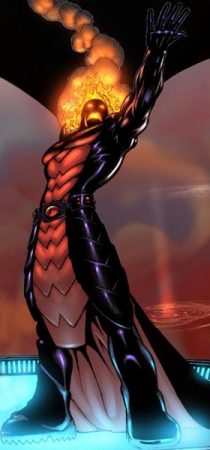
Dormammu is like Loki a god from another dimension, only he runs that dimension. In the mythology created by the Catholics where Satan rules in Hell, Dormammu is Satan under another name only the hero of the story aligns with the villain in times of trouble to save the Devil's servants. making the mistake we all make, thinking his servants are innocent, and they are drawn as such.
Perhaps the first response is to the notion of other dimensions. The idea of other worlds comes from God and gets copied into mythology and "modern" notions in quantum physics . Spiritual worlds beyond this one are mentioned in Job, regarded as the oldest Bible book:
Job 11:7 Are you able to take God's measure, to make discovery of the limits of the Ruler of all?
8 They are higher than heaven; what is there for you to do? deeper than the underworld, and outside your knowledge;
9 Longer in measure than the earth, and wider than the sea.
(BBE)
Some New Age scholars would claim Zoroaster as the source of this idea, but they neglect to mention the actual dating of that false prophet's life could be anywhere from a decades before the Israeli captivity in Babylon to the years of that captivity when Z culd have been "borrowing" a few things from Judaism. For certain it is mentioned in Job. But the idea of endless realities explored by the Justice League, Earth One, Earth Two and on and on exists because there is so much evidence the very universe itself could not exist without certain elements being in correct balance. the odds against such events occurring in one instance are so great as to suggest creation rather than randomness. The mutli-verse idea suggests the randomness has been trying over and over to create the right situation so there are endless other universes where other conditions do exist and, hence, other life-forms. (From wikipedia)
Perhaps the first response is to the notion of other dimensions. The idea of other worlds comes from God and gets copied into mythology and "modern" notions in quantum physics . Spiritual worlds beyond this one are mentioned in Job, regarded as the oldest Bible book:
Job 11:7 Are you able to take God's measure, to make discovery of the limits of the Ruler of all?
8 They are higher than heaven; what is there for you to do? deeper than the underworld, and outside your knowledge;
9 Longer in measure than the earth, and wider than the sea.
(BBE)
Some New Age scholars would claim Zoroaster as the source of this idea, but they neglect to mention the actual dating of that false prophet's life could be anywhere from a decades before the Israeli captivity in Babylon to the years of that captivity when Z culd have been "borrowing" a few things from Judaism. For certain it is mentioned in Job. But the idea of endless realities explored by the Justice League, Earth One, Earth Two and on and on exists because there is so much evidence the very universe itself could not exist without certain elements being in correct balance. the odds against such events occurring in one instance are so great as to suggest creation rather than randomness. The mutli-verse idea suggests the randomness has been trying over and over to create the right situation so there are endless other universes where other conditions do exist and, hence, other life-forms. (From wikipedia)
The fine-tuned Universe is the proposition that the conditions that allow life in the Universe can only occur when certain universal fundamental physical constants lie within a very narrow range, so that if any of several fundamental constants were only slightly different, the Universe would be unlikely to be conducive to the establishment and development of matter, astronomical structures, elemental diversity, or life as it is understood.[1][2][3][4] The possible explanations for fine-tuning are discussed among philosophers, scientists, theologians, and proponents and detractors of creationism. The fine-tuned Universe observation is closely related to, but is not exactly synonymous with, the anthropic principle, which is often used as an explanation of the observation.
History[edit]
In 1913, the chemist Lawrence Joseph Henderson (1878–1942) wrote The Fitness of the Environment, one of the first books to explore concepts of fine tuning in the Universe. Henderson discusses the importance of water and the environment with respect to living things, pointing out that life depends entirely on the very specific environmental conditions on Earth, especially with regard to the prevalence and properties of water.[5]
In 1961, the physicist Robert H. Dicke claimed that certain forces in physics, such as gravity and electromagnetism, must be perfectly fine-tuned for life to exist anywhere in the Universe.[6][7] Fred Hoyle also argued for a fine-tuned Universe in his 1984 book Intelligent Universe. He compares "the chance of obtaining even a single functioning protein by chance combination of amino acids to a star system full of blind men solving Rubik's Cube simultaneously".[8]
John Gribbin and Martin Rees wrote a detailed history and defence of the fine-tuning argument in their book Cosmic Coincidences (1989). According to Gribbin and Rees, "The conditions in our Universe really do seem to be uniquely suitable for life forms like ourselves, and perhaps even for any form of organic complexity. But the question remains - isthe Universe tailor-made for man?"[2]
Premise[edit]
The premise of the fine-tuned Universe assertion is that a small change in several of the dimensionless fundamental physical constants would make the Universe radically different. As Stephen Hawking has noted, "The laws of science, as we know them at present, contain many fundamental numbers, like the size of the electric charge of the electron and the ratio of the masses of the proton and the electron. ... The remarkable fact is that the values of these numbers seem to have been very finely adjusted to make possible the development of life."[4]
If, for example, the strong nuclear force were 2% stronger than it is (for example, if the coupling constant representing its strength were 2% larger), while the other constants were left unchanged, diprotons would be stable; according to physicist Paul Davies, hydrogen would fuse into them instead of deuterium and helium.[9] This would drastically alter the physics of stars, and presumably preclude the existence of life similar to what we observe on Earth. The existence of the diproton would short-circuit the slow fusion of hydrogen into deuterium. Hydrogen would fuse so easily that it is likely that all of the Universe's hydrogen would be consumed in the first few minutes after the Big Bang.[9] This "diproton argument" is disputed by other physicists, who calculate that as long as the increase in strength is less than 50%, stellar fusion could occur despite the existence of stable diprotons.[10]
The precise formulation of the idea is made difficult by the fact that physicists do not yet know how many independent physical constants there are. The current standard model of particle physics has 25 freely adjustable parameters with an additional parameter, the cosmological constant, for gravitation. However, because the standard model is not mathematically self-consistent under certain conditions (e.g., at very high energies, at which both quantum mechanics and general relativity are relevant), physicists believe that it is underlaid by some other theory, such as a grand unified theory, string theory, or loop quantum gravity. In some candidate theories, the actual number of independent physical constants may be as small as one. For example, the cosmological constant may be a fundamental constant, but attempts have also been made to calculate it from other constants, and according to the author of one such calculation, "the small value of the cosmological constant is telling us that a remarkably precise and totally unexpected relation exists among all the parameters of the Standard Model of particle physics, the bare cosmological constant and unknown physics."[11]
Examples[edit]
Martin Rees formulates the fine-tuning of the Universe in terms of the following six dimensionless physical constants.[1][12]
- N, the ratio of the strength of electromagnetism to the strength of gravity for a pair of protons, is approximately 1036. According to Rees, if it were significantly smaller, only a small and short-lived universe could exist.[12]
- Epsilon (ε), a measure of the nuclear efficiency of fusion from hydrogen to helium, is 0.007: when four nucleons fuse into helium, 0.007 (0.7%) of their mass is converted to energy. The value of ε is in part determined by the strength of the strong nuclear force.[13] If ε were 0.006, only hydrogen could exist, and complex chemistry would be impossible. According to Rees, if it were above 0.008, no hydrogen would exist, as all the hydrogen would have been fused shortly after the big bang. Other physicists disagree, calculating that substantial hydrogen remains as long as the strong force coupling constant increases by less than about 50%.[10][12]
- Omega (Ω), commonly known as the density parameter, is the relative importance of gravity and expansion energy in the Universe. It is the ratio of the mass density of the Universe to the "critical density" and is approximately 1. If gravity were too strong compared with dark energy and the initial metric expansion, the universe would have collapsed before life could have evolved. On the other side, if gravity were too weak, no stars would have formed.[12][14]
- Lambda (λ), commonly known as the cosmological constant, describes the ratio of the density of dark energy to the critical energy density of the universe, given certain reasonable assumptions such as positing that dark energy density is a constant. In terms of Planck units, and as a natural dimensionless value, the cosmological constant, λ, is on the order of 10−122.[15] This is so small that it has no significant effect on cosmic structures that are smaller than a billion light-years across. If the cosmological constant were not extremely small, stars and other astronomical structures would not be able to form.[12]
- Q, the ratio of the gravitational energy required to pull a large galaxy apart to the energy equivalent of its mass, is around 10−5. If it is too small, no stars can form. If it is too large, no stars can survive because the universe is too violent, according to Rees.[12]
- D, the number of spatial dimensions in spacetime, is 3. Rees claims that life could not exist if there were 2 or 4.[12]
Carbon and oxygen[edit]
Further information: Triple-alpha process § Improbability and fine-tuning
An older example is the Hoyle state, the third-lowest energy state of the carbon-12 nucleus, with an energy of 7.656 MeV above the ground level. According to one calculation, if the state's energy were lower than 7.3 or greater than 7.9 MeV, insufficient carbon would exist to support life; furthermore, to explain the universe's abundance of carbon, the Hoyle state must be further tuned to a value between 7.596 and 7.716 MeV. A similar calculation, focusing on the underlying fundamental constants that give rise to various energy levels, concludes that the strong force must be tuned to a precision of at least 0.5%, and the electromagnetic force to a precision of at least 4%, to prevent either carbon production or oxygen production from dropping significantly.[16]
Disputes regarding the existence and extent of fine-tuning[edit]
Physicist Paul Davies has asserted that "There is now broad agreement among physicists and cosmologists that the Universe is in several respects 'fine-tuned' for life". However, he continues, "the conclusion is not so much that the Universe is fine-tuned for life; rather it is fine-tuned for the building blocks and environments that life requires." He also states that "'anthropic' reasoning fails to distinguish between minimally biophilic universes, in which life is permitted, but only marginally possible, and optimally biophilic universes, in which life flourishes because abiogenesis occurs frequently".[17] Among scientists who find the evidence persuasive, a variety of explanations have been proposed, such as the anthropic principle along with multiple universes. George F. R. Ellis states "that no possible astronomical observations can ever see those other universes. The arguments are indirect at best. And even if the multiverse exists, it leaves the deep mysteries of nature unexplained."[18]
Regarding recently discovered dark energy and its implication on the cosmological constant, Leonard Susskind says "The great mystery is not why there is dark energy. The great mystery is why there is so little of it [10−122]... The fact that we are just on the knife edge of existence, [that] if dark energy were very much bigger we wouldn’t be here, that's the mystery." A slightly larger quantity of dark energy, or a slightly larger value of the cosmological constant would have caused space to expand rapidly enough that galaxies would not form.[19] Despite this, Susskind does not necessarily see the universe as being fine-tuned, suggesting that some parts of the "megaverse" in which we live might just, by chance, be suitable for the emergence of life, while other parts might not be.[20]
Steven Weinberg rejects the argument about the fine-tuning of the carbon cycle, arguing that "the fine-tuning of the constants of nature here does not seem so fine". He acknowledges that he currently has no explanation (apart from a multiverse) for the smallness of the cosmological constant, but cautions that "It is still too early to tell whether there is some fundamental principle that can explain why the cosmological constant must be this small."[21][22]
Physicist Victor Stenger objects to the fine-tuning, and especially to theist use of fine-tuning arguments. His numerous criticisms include what he calls "the wholly unwarranted assumption that only carbon-based life is possible."[23] In turn, the astrophysicist Luke Barnes has criticised much of Stenger's work.[24]
The validity of fine tuning examples is sometimes questioned on the grounds that such reasoning is subjective anthropomorphism applied to natural physical constants. Critics also suggest that the fine-tuned Universe assertion and the anthropic principle are essentially tautologies.[25]
The fine-tuned Universe argument has also been criticized as an argument by lack of imagination, as it assumes no other forms of life, sometimes referred to as carbon chauvinism. Conceptually, alternative biochemistry or other forms of life are possible.[26] Regarding this, Stenger argues: "We have no reason to believe that our kind of carbon-based life is all that is possible. Furthermore, modern cosmology theorises that multiple universes may exist with different constants and laws of physics. So, it is not surprising that we live in the one suited for us. The Universe is not fine-tuned to life; life is fine-tuned to the Universe."[27]
In addition, critics argue that humans are adapted to the Universe through the process of evolution, rather than the Universe being adapted to humans (see puddle thinking, below). They also see it as an example of the logical flaw of hubris or anthropocentrism in its assertion that humans are the purpose of the Universe.[28]
Possible naturalistic explanations[edit]
There are fine tuning arguments that are naturalistic.[29][page needed] As modern cosmology developed, various hypotheses have been proposed. One is an oscillatory universe or a multiverse, where fundamental physical constants are postulated to resolve themselves to random values in different iterations of reality.[30] Under this hypothesis, separate parts of reality would have wildly different characteristics. In such scenarios, the issue of fine-tuning does not arise at all, as only those "universes" with constants hospitable to life (such as what we observe) would develop life capable of contemplating the question of the origin of fine-tuning.
Multiverse[edit]
Main article: Multiverse
The Multiverse hypothesis proposes the existence of many universes with different physical constants, some of which are hospitable to intelligent life (see multiverse: anthropic principle). Because we are intelligent beings, we are, by definition, in a hospitable universe.
This idea has led to considerable research into the anthropic principle and has been of particular interest to particle physicists, because theories of everything do apparently generate large numbers of universes in which the physical constants vary widely. As yet, there is no evidence for the existence of a multiverse, but some versions of the theory do make predictions that some researchers studying M-theory and gravity leaks hope to see some evidence of soon.[31] Some multiverse theories are not falsifiable, thus scientists may be reluctant to call any multiverse theory "scientific". UNC-Chapel Hill professor Laura Mersini-Houghton claims that the WMAP cold spot may provide testable empirical evidence for a parallel universe,[32] although this claim was recently refuted as the WMAP cold spot was found to be nothing more than a statistical artifact.[33] Variants on this approach include Lee Smolin's notion of cosmological natural selection, the Ekpyrotic universe, and the Bubble universe theory.
Critics of the multiverse-related explanations argue that there is no evidence that other universes exist.
Top-down cosmology[edit]
Stephen Hawking, along with Thomas Hertog of CERN, proposed that the Universe's initial conditions consisted of a superposition of many possible initial conditions, only a small fraction of which contributed to the conditions we see today.[34] According to their theory, it is inevitable that we find our Universe's "fine-tuned" physical constants, as the current Universe "selects" only those past histories that led to the present conditions. In this way, top-down cosmology provides an anthropic explanation for why we find ourselves in a universe that allows matter and life, without invoking the ontic existence of the Multiverse.[35]
Alien design[edit]
One hypothesis is that the Universe may have been designed by extra-universal aliens. Some believe this would solve the problem of how a designer or design team capable of fine-tuning the Universe could come to exist. Cosmologist (that is SF believer with a pseudo degree. W.)Alan Guth believes humans will in time be able to generate new universes.[36] By implication previous intelligent entities may have generated our Universe.[37] This idea leads to the possibility that the extraterrestrial designer/designers are themselves the product of an evolutionary process in their own universe, which must therefore itself be able to sustain life. However it also raises the question of where that universe came from, leading to an infinite regress.
The Designer Universe theory of John Gribbin suggests that the Universe could have been made deliberately by an advanced civilization in another part of the Multiverse, and that this civilization may have been responsible for causing the Big Bang.[38]
(Which means these folks will do anything to not believe in God. W.)
Religious arguments[edit]
As with theistic evolution, some individual scientists, theologians, and philosophers as well as certain religious groups argue that providence or creation are responsible for fine-tuning.
Philosopher Alvin Plantinga argues that random chance, applied to a single and sole universe, only raises the question as to why this universe could be so "lucky" as to have precise conditions that support life at least at some place (the Earth) and time (within millions of years of the present).
This fine-tuning of the Universe is cited[40] by philosopher and Christian apologist William Lane Craig as an evidence for the existence of God or some form of intelligence capable of manipulating (or designing) the basic physics that governs the Universe. Craig argues, however, "that the postulate of a divine Designer does not settle for us the religious question."
Philosopher and theologian Richard Swinburne reaches the design conclusion using Bayesian probability.[41][page needed]
Theologian Alister McGrath has pointed out that the fine-tuning of carbon is even responsible for nature’s ability to tune itself to any degree.
Theoretical physicist John Polkinghorne has stated: Anthropic fine tuning is too remarkable to be dismissed as just a happy accident.[44]
Intelligent design[edit]
Proponents of Intelligent design argue that certain features of the Universe and of living things are best explained by an intelligent cause, not an undirected process such as natural selection. The fine-tuned Universe argument is a central premise or presented as given in many of the published works of prominent intelligent design proponents, such as William A. Dembski and Michael Behe.
Whether we agree with the fin-e tuning idea or not, we all must realize the spinning, mind bending world of Strange does not exist. We cannot alter reality with our minds: we can only alter our own perception of reality. one reason sorcerer comes from the French word meaning 'caster of lots'. Someone who gambles, takes a risk. Puts his life in the hands of luck, fate. Essentially saying, there is not control over the forces unleashed. But the word in Greek comes from Pharmakeia. From Strong's Concordance:
φαρμακεία (WH κια, so T (except in Galatians 5:20; cf. the Proleg., p. 88); see Iota), φαρμακείας, ἡ (φαρμακεύω);
φαρμακεία (WH κια, so T (except in Galatians 5:20; cf. the Proleg., p. 88); see Iota), φαρμακείας, ἡ (φαρμακεύω);
a. the use or the administering of drugs (Xenophon, mem. 4, 2, 17).
b. poisoning (Plato, Polybius, others): Revelation 9:21 (here WH text Tr marginal reading φαρμακῶν; many interpretations refer the passage to the next entry).
c. sorcery, magical arts, often found in connection with idolatry and fostered by it: Galatians 5:20 (where see Lightfoot) (Wis. 12:4 Wis. 18:13; for כְּשָׁפִים, Isaiah 47:9; for לָטִים, Exodus 7:22; Exodus 8:18; for לְהָטִים, Exodus 7:11); tropically, of the deceptions and seductions of idolatry, Revelation 18:23.
Question: "What does the Bible say about sorcery?"
Answer: Sorcery, the use of spells, divination, or speaking to spirits, is clearly condemned in the Bible. The word sorcery in Scripture is always used in reference to an evil or deceptive practice.
For example, in 2 Chronicles 33:6, King Manasseh is condemned for his many evil practices, including sorcery: “And he burned his sons as an offering in the Valley of the Son of Hinnom, and used fortune-telling and omens and sorcery, and dealt with mediums and with necromancers. He did much evil in the sight of the LORD, provoking him to anger.”
The apostle Paul lists sorcery as one of many sinful practices that mark the lives of unbelievers: “Now the works of the flesh are evident: sexual immorality, impurity, sensuality, idolatry, sorcery, enmity, strife . . . and things like these. I warn you, as I warned you before, that those who do such things will not inherit the kingdom of God” (Galatians 5:19-21).
Interestingly, the New Testament Greek word translated “sorcery” is pharmakeia, which is the source of our English word pharmacy. In Paul’s day, the word primarily meant “dealing in poison” or “drug use” and was applied to divination and spell-casting because sorcerers often used drugs along with their incantations and amulets to conjure occult power.
Sorcerers were common in the culture of ancient Egypt (Exodus 7:11; Isaiah 19:3). We also see sorcery in the kingdom of Babylon, especially in association with King Nebuchadnezzar (Jeremiah 27:9; Daniel 2:2).
Sorcery is an attempt to bypass God’s wisdom and power and give glory to Satan instead. God has no tolerance for sorcery. In Deuteronomy 18:10-12, sorcery is listed among the sinful practices of the nations surrounding Israel. God calls it an abomination: “There shall not be found among you . . . anyone who practices divination or tells fortunes or interprets omens, or a sorcerer or a charmer or a medium or a necromancer or one who inquires of the dead, for whoever does these things is an abomination to the LORD. And because of these abominations the LORD your God is driving them out before you.”
Malachi also speaks of God’s judgment on those involved in sorcery: “Then I will draw near to you for judgment. I will be a swift witness against the sorcerers” (Malachi 3:5).
Apparently, sorcery will still be practiced in the end times. Spiritual Babylon, representing the false religious system of the last days, will deceive “all nations” with sorcery (Revelation 18:23) before judgment falls.
The book of Revelation says that sorcerers “will be in the lake that burns with fire and sulfur, which is the second death” (Revelation 21:8; see also Revelation 22:15).
Sorcery is clearly sinful and is not to be part of Christian living. There is a wisdom that is “earthly, unspiritual, of the devil” (James 3:15), and this is what sorcery offers. Our wisdom comes from God (James 3:17), not from deceiving spirits. The power of God is much greater than the power of sorcery (1 John 4:4).
Answer: Sorcery, the use of spells, divination, or speaking to spirits, is clearly condemned in the Bible. The word sorcery in Scripture is always used in reference to an evil or deceptive practice.
For example, in 2 Chronicles 33:6, King Manasseh is condemned for his many evil practices, including sorcery: “And he burned his sons as an offering in the Valley of the Son of Hinnom, and used fortune-telling and omens and sorcery, and dealt with mediums and with necromancers. He did much evil in the sight of the LORD, provoking him to anger.”
The apostle Paul lists sorcery as one of many sinful practices that mark the lives of unbelievers: “Now the works of the flesh are evident: sexual immorality, impurity, sensuality, idolatry, sorcery, enmity, strife . . . and things like these. I warn you, as I warned you before, that those who do such things will not inherit the kingdom of God” (Galatians 5:19-21).
Interestingly, the New Testament Greek word translated “sorcery” is pharmakeia, which is the source of our English word pharmacy. In Paul’s day, the word primarily meant “dealing in poison” or “drug use” and was applied to divination and spell-casting because sorcerers often used drugs along with their incantations and amulets to conjure occult power.
Sorcerers were common in the culture of ancient Egypt (Exodus 7:11; Isaiah 19:3). We also see sorcery in the kingdom of Babylon, especially in association with King Nebuchadnezzar (Jeremiah 27:9; Daniel 2:2).
Sorcery is an attempt to bypass God’s wisdom and power and give glory to Satan instead. God has no tolerance for sorcery. In Deuteronomy 18:10-12, sorcery is listed among the sinful practices of the nations surrounding Israel. God calls it an abomination: “There shall not be found among you . . . anyone who practices divination or tells fortunes or interprets omens, or a sorcerer or a charmer or a medium or a necromancer or one who inquires of the dead, for whoever does these things is an abomination to the LORD. And because of these abominations the LORD your God is driving them out before you.”
Malachi also speaks of God’s judgment on those involved in sorcery: “Then I will draw near to you for judgment. I will be a swift witness against the sorcerers” (Malachi 3:5).
Apparently, sorcery will still be practiced in the end times. Spiritual Babylon, representing the false religious system of the last days, will deceive “all nations” with sorcery (Revelation 18:23) before judgment falls.
The book of Revelation says that sorcerers “will be in the lake that burns with fire and sulfur, which is the second death” (Revelation 21:8; see also Revelation 22:15).
Sorcery is clearly sinful and is not to be part of Christian living. There is a wisdom that is “earthly, unspiritual, of the devil” (James 3:15), and this is what sorcery offers. Our wisdom comes from God (James 3:17), not from deceiving spirits. The power of God is much greater than the power of sorcery (1 John 4:4).
Stephen Strange is a comic character who is a false prophet who will have disciples and followers and women who love the actor portraying him and will last for a while, a Fallen Flesh legend for this age and time. Unlike the eternal story of Moses.

No comments:
Post a Comment