JUDGES, THE CHURCH AND FORESHADOWING: PART 4
Re 2:18 And to the angel of the church in Thyatira say: These things says the Son of God, whose eyes are like a flame of fire, and his feet like polished brass:
19 I have knowledge of your works, and your love and faith and help and strength in trouble, and that your last works are more than the first.
20 But I have this against you, that you let the woman Jezebel say she is a prophet and give false teaching, making my servants go after the desires of the flesh and take food offered to false gods.
21 And I gave her time for a change of heart, but she has no mind to give up her unclean ways.
22 See, I will put her into a bed, and those who make themselves unclean with her, into great trouble, if they go on with her works.
23 And I will put her children to death; and all the churches will see that I am he who makes search into the secret thoughts and hearts of men: and I will give to every one of you the reward of your works.
24 But to you I say, to the rest in Thyatira, even to those who have not this teaching, and have no knowledge of the secrets of Satan, as they say; I put on you no other weight.
25 But what you have, keep safe till I come.
26 He who overcomes, and keeps my works to the end, to him I will give rule over the nations,
27 And he will be ruling them with a rod of iron; as the vessels of the potter they will be broken, even as I have power from my Father:
28 And I will give him the morning star.
29 He who has ears, let him give ear to what the Spirit says to the churches.
(BBE)
A moment to consider that the defeat of Moab in Judges led to the tale of Ruth, a Moabite woman who married into Israel's life, lost her husband bit carried on to tend to her mother-in-law and earned the admiration of a rich relative who became her husband.
https://www.gotquestions.org/Ruth-and-Boaz.html
The book of Ruth largely focuses on the relationship between Ruth and Boaz. Ruth was a Moabite woman had come to Israel as the widow of an Israelite man. She had returned with her mother-in-law, Naomi, who had also lost her husband. They lived together in a humble situation, and Ruth would go to the fields each day to glean food in the fields during the harvest.
Boaz was a landowner where Ruth came to find grain. He knew of her situation and told his workers to leave plenty of grain for her to find. Boaz also offered her food with the other workers and encouraged her to work in the safety of his fields throughout the harvest.
Naomi noted that Boaz was a close relative who, according to Jewish law, had the right to marry Ruth after the death of her husband. Naomi encouraged Ruth to go to Boaz in the evening and present herself willing to accept a marriage proposal from him. When she did, he was pleased, yet noted that there was one relative who was closer in line to marry Ruth.
The next day, Boaz met with this relative and presented the situation. The relative turned down the offer as he felt it would cause harm to his own family situation. Boaz then made a commitment in front of the town’s leaders that he would take Ruth as his wife.
Boaz and Ruth were married and soon had a son named Obed. Naomi’s misfortune had turned to joy as she became a grandmother. Obed would later become the grandfather of King David, who would also serve as an ancestor of Jesus Christ.
Ruth is one of four women specifically named in Matthew’s genealogy of Jesus. Matthew 1:5–6 says, “Boaz the father of Obed, whose mother was Ruth, Obed the father of Jesse, and Jesse the father of King David.”
The story of Ruth and Boaz offers many wonderful insights for today. Among them is the principle that God often works through those who have endured tragic situations to change the lives of many others. Second, God will work through unlikely means. Ruth was a poor widow and a foreigner, yet God used her as part of the family line of both David and Jesus. Third, God’s sovereign power can be seen. He is in control of everything that happens, even when we do not understand the situation.
The Gentile enemy became one with the people of God, foreshadowing the gift Christ would give to all people, the story coming from the result of righteous conflict by righteous judges with no thought that there may be a long term results they could not foresee. We can perceive it now. Christians need to consider that what we do today has consequences we can't begin to grasp. What we do for good and what we do for evil. Every act of the Judges had an echo for the Lord later on because He created the world for things to be that way.
In Judges, as we move on there was the story of natural man.
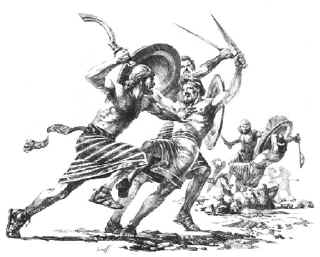
3:31 And after him came Shamgar, the son of Anath, who put to death six hundred Philistines with an ox-stick; and he was another saviour of Israel.
(BBE)
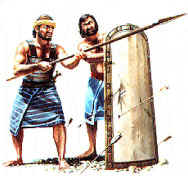
Samson would later use the jawbone of an ass on a Philistine killing spree. Shamgar acts as man using his own natural talents. About that ox-pick:
An ox goad, in the hands of a strong and capable man, would be able to wreak great damage on a foe. We learn that it was often 8 feet in length and as much as 6 inches in diameter at its large end, with the other end sharpened to a point. One can imagine the potential for such an instrument! Shamgar was evidently a man who, from his daily life and work, knew how to use an ox goad. (From Judges)
All manner of people have natural gifts and they can use them for the Lord in every way possible and He gives them honor as such, but notice that there is only that one victory, that moment. And then it is gone. No lasting results that the Bible notes. Not long term era of peace. Just that moment. It is well that there are those moments, but the long term reach of victory comes only with the Holy Spirit's gifting.
It rings more powerfully when you consider that so many men of the church of the era Thyatira represents for the Catholic church age operated on their own gifting. The priesthood became a matter of study and diligence and sometimes of wealth or nepotism. All signs became regarded as pagan. Talking in tongues was labeled demonic. The Spirit's gifting was ignored. And, as a result, few things of the miraculous are recorded from the Dark Ages.
Meanwhile the enemy rising next against Israel was Canaan.
A period of relative peace prevailed for 80 years following Ehud’s victory over Moab. Some extra-Biblical sources give an indication why this was possible, apart from Israel possibly continuing in a measure of faithfulness to God during that time. One element, no doubt used of God to hold their enemies at bay, was that Egypt was actively moving in the southern part of Canaan and was exercising strong control in the region. This effect would have hindered Israel’s neighboring nations from moving offensively against God’s people (“Distressing Days of the Judges”, Leon Wood). God can and does use contentions between nations to hinder their activities of oppression toward His people when need be. However, that Egyptian influence apparently waned, and it gave opportunity for Jabin and Sisera to increase Canaanite domination and oppression of Israel. This was evidently coupled with Israel’s increasing departure from the Lord that resulted in God bringing discipline on His people once again.
(From Judges again)
Outside forces and internal conflict. These would sound familiar to the Church at Thyatira. They were a defense city, set on a plain and more vulnerable to attack than you would expect of a fortress city meant to defend the Roman interior. They had been destroyed and rebuilt even as Israel would be destroyed and rebuilt over and over.
"Thyatira was situated in the mouth of a long vale which extends north and south connecting the Hermus and Caicos Valleys. Down the vale a stream flows south to join the Lycus (near whose left bank Thyatira was situated), one of the chief tributaries of the Hermus, while its northern end is divided by only a ridge of small elevation from the Caicos Valley. The valleys of the two rivers, Hermus and Caicos, stretch east and west, opening down from the edge of the great central plateau of Anatolia towards the Aegean Sea. Nature has marked out this road, a very easy path, for the tide of communication which in all civilized times must have been large between the one valley and the other. The railway traverses its whole length now: in ancient times one of the chief routes of Asia Minor traversed it."
–Sir William Ramsay
Two major rivers flowed there. They met and mingled. One wouldn't know which current came from which river.
The Church at Thyatira. Regarded by historicist and futurists as the symbol of the church in the Dark Ages. The ways of the Roman Empire had become thoroughly mingled with the ways of Christianity. One could hardly discern the difference.
https://www.bl.uk/the-middle-ages/articles/church-in-the-middle-ages-from-dedication-to-dissent
"The success of the Church as a dominant force can be attributed in no small measure to its highly developed organisation, which over the course of the Middle Ages developed a sophisticated system of governance, law and economy.
"The institutional Church can be divided into two unequal parts: the larger of the two was the secular church, and the other was the regular church, so called because its members followed a monastic rule (regula, in Latin). The secular church, attended by the general population, was carved into regions governed by archbishops, and their territory was in turn divided into areas known as diocese, which were administered by bishops. The parish church was the basic unit of the Christian community, providing the sacraments required by the lay community. For most medieval Christians, religious experience was focused on a parish church which they attended, at least in theory, on Sundays and religious festivals.
"The regular church, by contrast, consisted of men and women who had sworn vows of obedience, celibacy and poverty. Most of these people lived in communities governed by a 'rule', a book of instructions. The most influential and widespread rule was the Rule of St Benedict (c. 620 - 30), which set out a detailed routine consisting of manual labour, prayer and study.
"Numerous other religious orders, some stricter and others more lenient, proliferated in the Middle Ages: these can be categorised as monastic orders, mendicant orders, and military orders. Monks and nuns tried to remove themselves as much as possible from the secular world, ideally living in communities with minimal contact with the outside world.
"Derived from the Latin word 'to beg' (mendicare), the mendicants were orders who engaged with ordinary people by preaching to them and hearing confession. The military orders were made up of knights who participated in the crusades which sought to capture the Holy Land and convert Muslims to Christianity.
"Pilgrimages to holy places enabled the faithful to atone from their sins, seek miraculous cures and extend their experience of the world. Bodily remains of saints, and also objects associated with them (such as the Virgin's mantle, the holiest relic at Chartres Cathedral), were the star attractions for pilgrims. Pilgrims might travel relatively short distnaces to see and touch the shrines of local saints, or undertake more ambitious (and dangerous) journeys. The most popular destinations were Rome, Santiago de Compostela in Spain, the Holy Land, and Canterbury. Geoffrey Chaucer's Canterbury Tales, famously set on a journey from London to Thomas Becket's shrine at Canterbury Cathedral, presents a sometimes sharply ironic view of the pilgrims and their motives."
It was the active secular church that seems to be the commendation part of Jesus letter to them:
19 I have knowledge of your works, and your love and faith and help and strength in trouble, and that your last works are more than the first.
Back in the time of Judges, we have another scene where the mixing of the currents of God and idols had led to trouble:
Jg 4:1 And the children of Israel again did evil in the eyes of the Lord when Ehud was dead.
2 And the Lord gave them up into the hands of Jabin, king of Canaan, who was ruling in Hazor; the captain of his army was Sisera, who was living in Harosheth of the Gentiles.
3 Then the children of Israel made prayer to the Lord; for he had nine hundred iron war-carriages, and for twenty years he was very cruel to the children of Israel.
4 Now Deborah, a woman prophet, the wife of Lapidoth, was judge of Israel at that time.
5 (And she had her seat under the palm-tree of Deborah between Ramah and Beth-el in the hill-country of Ephraim; and the children of Israel came up to her to be judged.)
6 And she sent for Barak, the son of Abinoam, from Kedesh-naphtali, and said to him, Has not the Lord, the God of Israel, given orders saying, Go and get your force into line in Mount Tabor, and take with you ten thousand men of the children of Naphtali and of the children of Zebulun?
7 And I will make Sisera, the captain of Jabin's army, with his war-carriages and his forces, come against you at the river Kishon, where I will give him into your hands.
8 And Barak said to her, If you will go with me then I will go; but if you will not go with me I will not go.
9 And she said, I will certainly go with you: though you will get no honour in your undertaking, for the Lord will give Sisera into the hands of a woman. So Deborah got up and went with Barak to Kedesh.
10 Then Barak sent for Zebulun and Naphtali to come to Kedesh; and ten thousand men went up after him, and Deborah went up with him.
11 Now Heber the Kenite, separating himself from the rest of the Kenites, from the children of Hobab, the brother-in-law of Moses, had put up his tent as far away as the oak-tree in Zaanannim, by Kedesh.
12 And word was given to Sisera that Barak, the son of Abinoam, had gone up to Mount Tabor.
13 So Sisera got together all his war-carriages, nine hundred war-carriages of iron, and all the people who were with him, from Harosheth of the Gentiles as far as the river Kishon.
14 Then Deborah said to Barak, Up! for today the Lord has given Sisera into your hands: has not the Lord gone out before you? So Barak went down from Mount Tabor and ten thousand men after him.
15 And the Lord sent fear on Sisera and all his war-carriages and all his army before Barak; and Sisera got down from his war-carriage and went in flight on foot.
16 But Barak went after the war-carriages and the army as far as Harosheth of the Gentiles; and all Sisera's army was put to the sword; not a man got away.
17 But Sisera went in flight on foot to the tent of Jael, the wife of Heber the Kenite; for there was peace between Jabin, king of Hazor, and the family of Heber the Kenite.
18 And Jael went out to Sisera, and said to him, Come in, my lord, come in to me without fear. So he went into her tent, and she put a cover over him.
19 Then he said to her, Give me now a little water, for I have need of a drink. And opening a skin of milk, she gave him drink, and put the cover over him again.
20 And he said to her, Take your place at the door of the tent, and if anyone comes and says to you, Is there any man here, say, No.
21 Then Jael, Heber's wife, took a tent-pin and a hammer and went up to him quietly, driving the pin into his head, and it went through his head into the earth, for he was in a deep sleep from weariness; and so he came to his end.
22 Then Jael went out, and meeting Barak going after Sisera, said to him, Come, and I will let you see the man you are searching for. So he came into her tent and saw, and there was Sisera stretched out dead with the tent-pin in his head.
23 So that day God overcame Jabin, king of Canaan, before the children of Israel.
24 And the power of the children of Israel went on increasing against Jabin, king of Canaan, till he was cut off.
(BBE)
In this case, a holy woman takes leadership when a man will not and they battle for God together and win a victory worthy of praise.
Recall we detailed the chariots previously. The great chariots with their heavy metal armor and heavy war horses sank into the muck of reality during the battle. Man's natural talents and skills being dragged into the mire by God's actions for His people. The muck of the river a holding ground for God.
Meanwhile Thyatira was in the muck of two rivers, a church stuck and unable to move forward for God. From a contemporary point of view:
https://www.biblegateway.com/resources/commentaries/IVP-NT/Rev/Message-Thyatira
i. In these words we see both the mercy and judgment of our Lord. Time to repent shows mercy. God gives us time to repent, we should deal with others the same way. And she did not repent speaks to the judgment of God. God gives time to repent, but it is not an unlimited time. There is a time when God says, My Spirit shall not strive with man forever (Genesis 6:3). This means that when God gives us time to repent, we must take advantage of that time.
With an expansion on the concept:
"Co-Redemptrix is a title used by some Roman Catholics for the Blessed Virgin Mary, as well as a Catholic theological concept referring to Mary's role in the redemption of man. It has always been controversial and has never formed part of the dogma of the Church. The term Co-Redemptrix refers to a subordinate but essential participation by the Blessed Virgin Mary in redemption, notably that she gave free consent to give life to the Redeemer, to share his life, to suffer with him under the cross, to offer his sacrifice to God the Father for the sake of the redemption of mankind. Related to this belief is the concept of Mary as Mediatrix, which is a separate concept but regularly included by faithful who use the title Co-Redemptrix.
Col 1:20 And, having made peace through the blood of his cross, by him to reconcile all things unto himself; by him, I say, whether they be things in earth, or things in heaven. {having...: or, making}
Jezebel was a personal godhood worshiper thinking she could replace God in the hearts of the people by putting her own people in charge and killing anyone who go in her way. Mary worship accomplishes the same thing with subtlety.
But there is one other woman here not mentioned but looming in the background: Lydia.
Very little is said in the Bible about Lydia. There is only one mention of her by name in Scripture—in Acts 16 we find the record of her conversion and her subsequent baptism (Acts 16:11–15). From the story of Lydia we can glean a few useful details about conversion, specifically about the conversion of Jewish believers.
Lydia in the Bible was originally from Thyatira but was living in Philippi when she met Paul on his second missionary journey. She was a seller of purple cloth, which Thyatira was famous for, being a center of indigo trade. Lydia apparently had moved to Philippi to ply her trade in that city. Archaeologists have found among the ruins of Thyatira inscriptions relating to a dyers’ guild in the city. It is possible that Lydia was a member of this guild, but there is no evidence from the Bible to prove that detail.
And to Lydia, to every true believer a song of triumph like that of Deborah's awaits and a promise from this section of Revelation abides:
Revelation 2:24 But unto you I say, and unto the rest in Thyatira, as many as have not this doctrine, and which have not known the depths of Satan, as they speak; I will put upon you none other burden.
25 But that which ye have already hold fast till I come.
26 And he that overcometh, and keepeth my works unto the end, to him will I give power over the nations:
27 And he shall rule them with a rod of iron; as the vessels of a potter shall they be broken to shivers: even as I received of my Father.
28 And I will give him the morning star.
19 I have knowledge of your works, and your love and faith and help and strength in trouble, and that your last works are more than the first.
20 But I have this against you, that you let the woman Jezebel say she is a prophet and give false teaching, making my servants go after the desires of the flesh and take food offered to false gods.
21 And I gave her time for a change of heart, but she has no mind to give up her unclean ways.
22 See, I will put her into a bed, and those who make themselves unclean with her, into great trouble, if they go on with her works.
23 And I will put her children to death; and all the churches will see that I am he who makes search into the secret thoughts and hearts of men: and I will give to every one of you the reward of your works.
24 But to you I say, to the rest in Thyatira, even to those who have not this teaching, and have no knowledge of the secrets of Satan, as they say; I put on you no other weight.
25 But what you have, keep safe till I come.
26 He who overcomes, and keeps my works to the end, to him I will give rule over the nations,
27 And he will be ruling them with a rod of iron; as the vessels of the potter they will be broken, even as I have power from my Father:
28 And I will give him the morning star.
29 He who has ears, let him give ear to what the Spirit says to the churches.
(BBE)
A moment to consider that the defeat of Moab in Judges led to the tale of Ruth, a Moabite woman who married into Israel's life, lost her husband bit carried on to tend to her mother-in-law and earned the admiration of a rich relative who became her husband.
https://www.gotquestions.org/Ruth-and-Boaz.html
The book of Ruth largely focuses on the relationship between Ruth and Boaz. Ruth was a Moabite woman had come to Israel as the widow of an Israelite man. She had returned with her mother-in-law, Naomi, who had also lost her husband. They lived together in a humble situation, and Ruth would go to the fields each day to glean food in the fields during the harvest.
Boaz was a landowner where Ruth came to find grain. He knew of her situation and told his workers to leave plenty of grain for her to find. Boaz also offered her food with the other workers and encouraged her to work in the safety of his fields throughout the harvest.
Naomi noted that Boaz was a close relative who, according to Jewish law, had the right to marry Ruth after the death of her husband. Naomi encouraged Ruth to go to Boaz in the evening and present herself willing to accept a marriage proposal from him. When she did, he was pleased, yet noted that there was one relative who was closer in line to marry Ruth.
The next day, Boaz met with this relative and presented the situation. The relative turned down the offer as he felt it would cause harm to his own family situation. Boaz then made a commitment in front of the town’s leaders that he would take Ruth as his wife.
Boaz and Ruth were married and soon had a son named Obed. Naomi’s misfortune had turned to joy as she became a grandmother. Obed would later become the grandfather of King David, who would also serve as an ancestor of Jesus Christ.
Ruth is one of four women specifically named in Matthew’s genealogy of Jesus. Matthew 1:5–6 says, “Boaz the father of Obed, whose mother was Ruth, Obed the father of Jesse, and Jesse the father of King David.”
The story of Ruth and Boaz offers many wonderful insights for today. Among them is the principle that God often works through those who have endured tragic situations to change the lives of many others. Second, God will work through unlikely means. Ruth was a poor widow and a foreigner, yet God used her as part of the family line of both David and Jesus. Third, God’s sovereign power can be seen. He is in control of everything that happens, even when we do not understand the situation.
The Gentile enemy became one with the people of God, foreshadowing the gift Christ would give to all people, the story coming from the result of righteous conflict by righteous judges with no thought that there may be a long term results they could not foresee. We can perceive it now. Christians need to consider that what we do today has consequences we can't begin to grasp. What we do for good and what we do for evil. Every act of the Judges had an echo for the Lord later on because He created the world for things to be that way.
In Judges, as we move on there was the story of natural man.
3:31 And after him came Shamgar, the son of Anath, who put to death six hundred Philistines with an ox-stick; and he was another saviour of Israel.
(BBE)
Samson would later use the jawbone of an ass on a Philistine killing spree. Shamgar acts as man using his own natural talents. About that ox-pick:
An ox goad, in the hands of a strong and capable man, would be able to wreak great damage on a foe. We learn that it was often 8 feet in length and as much as 6 inches in diameter at its large end, with the other end sharpened to a point. One can imagine the potential for such an instrument! Shamgar was evidently a man who, from his daily life and work, knew how to use an ox goad. (From Judges)
All manner of people have natural gifts and they can use them for the Lord in every way possible and He gives them honor as such, but notice that there is only that one victory, that moment. And then it is gone. No lasting results that the Bible notes. Not long term era of peace. Just that moment. It is well that there are those moments, but the long term reach of victory comes only with the Holy Spirit's gifting.
It rings more powerfully when you consider that so many men of the church of the era Thyatira represents for the Catholic church age operated on their own gifting. The priesthood became a matter of study and diligence and sometimes of wealth or nepotism. All signs became regarded as pagan. Talking in tongues was labeled demonic. The Spirit's gifting was ignored. And, as a result, few things of the miraculous are recorded from the Dark Ages.
Meanwhile the enemy rising next against Israel was Canaan.
A period of relative peace prevailed for 80 years following Ehud’s victory over Moab. Some extra-Biblical sources give an indication why this was possible, apart from Israel possibly continuing in a measure of faithfulness to God during that time. One element, no doubt used of God to hold their enemies at bay, was that Egypt was actively moving in the southern part of Canaan and was exercising strong control in the region. This effect would have hindered Israel’s neighboring nations from moving offensively against God’s people (“Distressing Days of the Judges”, Leon Wood). God can and does use contentions between nations to hinder their activities of oppression toward His people when need be. However, that Egyptian influence apparently waned, and it gave opportunity for Jabin and Sisera to increase Canaanite domination and oppression of Israel. This was evidently coupled with Israel’s increasing departure from the Lord that resulted in God bringing discipline on His people once again.
(From Judges again)
Outside forces and internal conflict. These would sound familiar to the Church at Thyatira. They were a defense city, set on a plain and more vulnerable to attack than you would expect of a fortress city meant to defend the Roman interior. They had been destroyed and rebuilt even as Israel would be destroyed and rebuilt over and over.
"Thyatira was situated in the mouth of a long vale which extends north and south connecting the Hermus and Caicos Valleys. Down the vale a stream flows south to join the Lycus (near whose left bank Thyatira was situated), one of the chief tributaries of the Hermus, while its northern end is divided by only a ridge of small elevation from the Caicos Valley. The valleys of the two rivers, Hermus and Caicos, stretch east and west, opening down from the edge of the great central plateau of Anatolia towards the Aegean Sea. Nature has marked out this road, a very easy path, for the tide of communication which in all civilized times must have been large between the one valley and the other. The railway traverses its whole length now: in ancient times one of the chief routes of Asia Minor traversed it."
–Sir William Ramsay
Two major rivers flowed there. They met and mingled. One wouldn't know which current came from which river.
The Church at Thyatira. Regarded by historicist and futurists as the symbol of the church in the Dark Ages. The ways of the Roman Empire had become thoroughly mingled with the ways of Christianity. One could hardly discern the difference.
https://www.bl.uk/the-middle-ages/articles/church-in-the-middle-ages-from-dedication-to-dissent
"The success of the Church as a dominant force can be attributed in no small measure to its highly developed organisation, which over the course of the Middle Ages developed a sophisticated system of governance, law and economy.
"The institutional Church can be divided into two unequal parts: the larger of the two was the secular church, and the other was the regular church, so called because its members followed a monastic rule (regula, in Latin). The secular church, attended by the general population, was carved into regions governed by archbishops, and their territory was in turn divided into areas known as diocese, which were administered by bishops. The parish church was the basic unit of the Christian community, providing the sacraments required by the lay community. For most medieval Christians, religious experience was focused on a parish church which they attended, at least in theory, on Sundays and religious festivals.
"The regular church, by contrast, consisted of men and women who had sworn vows of obedience, celibacy and poverty. Most of these people lived in communities governed by a 'rule', a book of instructions. The most influential and widespread rule was the Rule of St Benedict (c. 620 - 30), which set out a detailed routine consisting of manual labour, prayer and study.
"Numerous other religious orders, some stricter and others more lenient, proliferated in the Middle Ages: these can be categorised as monastic orders, mendicant orders, and military orders. Monks and nuns tried to remove themselves as much as possible from the secular world, ideally living in communities with minimal contact with the outside world.
"Derived from the Latin word 'to beg' (mendicare), the mendicants were orders who engaged with ordinary people by preaching to them and hearing confession. The military orders were made up of knights who participated in the crusades which sought to capture the Holy Land and convert Muslims to Christianity.
"Pilgrimages to holy places enabled the faithful to atone from their sins, seek miraculous cures and extend their experience of the world. Bodily remains of saints, and also objects associated with them (such as the Virgin's mantle, the holiest relic at Chartres Cathedral), were the star attractions for pilgrims. Pilgrims might travel relatively short distnaces to see and touch the shrines of local saints, or undertake more ambitious (and dangerous) journeys. The most popular destinations were Rome, Santiago de Compostela in Spain, the Holy Land, and Canterbury. Geoffrey Chaucer's Canterbury Tales, famously set on a journey from London to Thomas Becket's shrine at Canterbury Cathedral, presents a sometimes sharply ironic view of the pilgrims and their motives."
It was the active secular church that seems to be the commendation part of Jesus letter to them:
19 I have knowledge of your works, and your love and faith and help and strength in trouble, and that your last works are more than the first.
Back in the time of Judges, we have another scene where the mixing of the currents of God and idols had led to trouble:
Jg 4:1 And the children of Israel again did evil in the eyes of the Lord when Ehud was dead.
2 And the Lord gave them up into the hands of Jabin, king of Canaan, who was ruling in Hazor; the captain of his army was Sisera, who was living in Harosheth of the Gentiles.
3 Then the children of Israel made prayer to the Lord; for he had nine hundred iron war-carriages, and for twenty years he was very cruel to the children of Israel.
4 Now Deborah, a woman prophet, the wife of Lapidoth, was judge of Israel at that time.
5 (And she had her seat under the palm-tree of Deborah between Ramah and Beth-el in the hill-country of Ephraim; and the children of Israel came up to her to be judged.)
6 And she sent for Barak, the son of Abinoam, from Kedesh-naphtali, and said to him, Has not the Lord, the God of Israel, given orders saying, Go and get your force into line in Mount Tabor, and take with you ten thousand men of the children of Naphtali and of the children of Zebulun?
7 And I will make Sisera, the captain of Jabin's army, with his war-carriages and his forces, come against you at the river Kishon, where I will give him into your hands.
8 And Barak said to her, If you will go with me then I will go; but if you will not go with me I will not go.
9 And she said, I will certainly go with you: though you will get no honour in your undertaking, for the Lord will give Sisera into the hands of a woman. So Deborah got up and went with Barak to Kedesh.
10 Then Barak sent for Zebulun and Naphtali to come to Kedesh; and ten thousand men went up after him, and Deborah went up with him.
11 Now Heber the Kenite, separating himself from the rest of the Kenites, from the children of Hobab, the brother-in-law of Moses, had put up his tent as far away as the oak-tree in Zaanannim, by Kedesh.
12 And word was given to Sisera that Barak, the son of Abinoam, had gone up to Mount Tabor.
13 So Sisera got together all his war-carriages, nine hundred war-carriages of iron, and all the people who were with him, from Harosheth of the Gentiles as far as the river Kishon.
14 Then Deborah said to Barak, Up! for today the Lord has given Sisera into your hands: has not the Lord gone out before you? So Barak went down from Mount Tabor and ten thousand men after him.
15 And the Lord sent fear on Sisera and all his war-carriages and all his army before Barak; and Sisera got down from his war-carriage and went in flight on foot.
16 But Barak went after the war-carriages and the army as far as Harosheth of the Gentiles; and all Sisera's army was put to the sword; not a man got away.
17 But Sisera went in flight on foot to the tent of Jael, the wife of Heber the Kenite; for there was peace between Jabin, king of Hazor, and the family of Heber the Kenite.
18 And Jael went out to Sisera, and said to him, Come in, my lord, come in to me without fear. So he went into her tent, and she put a cover over him.
19 Then he said to her, Give me now a little water, for I have need of a drink. And opening a skin of milk, she gave him drink, and put the cover over him again.
20 And he said to her, Take your place at the door of the tent, and if anyone comes and says to you, Is there any man here, say, No.
21 Then Jael, Heber's wife, took a tent-pin and a hammer and went up to him quietly, driving the pin into his head, and it went through his head into the earth, for he was in a deep sleep from weariness; and so he came to his end.
22 Then Jael went out, and meeting Barak going after Sisera, said to him, Come, and I will let you see the man you are searching for. So he came into her tent and saw, and there was Sisera stretched out dead with the tent-pin in his head.
23 So that day God overcame Jabin, king of Canaan, before the children of Israel.
24 And the power of the children of Israel went on increasing against Jabin, king of Canaan, till he was cut off.
(BBE)
In this case, a holy woman takes leadership when a man will not and they battle for God together and win a victory worthy of praise.
Recall we detailed the chariots previously. The great chariots with their heavy metal armor and heavy war horses sank into the muck of reality during the battle. Man's natural talents and skills being dragged into the mire by God's actions for His people. The muck of the river a holding ground for God.
Meanwhile Thyatira was in the muck of two rivers, a church stuck and unable to move forward for God. From a contemporary point of view:
https://www.biblegateway.com/resources/commentaries/IVP-NT/Rev/Message-Thyatira
For some people today tolerance is the only real virtue and intolerance the only vice. The message to Thyatira goes against the grain of modernity by setting limits to tolerance. The main criticism of the angel of Thyatira is that he has tolerated something--and someone--that should not be tolerated (v. 20).
Thyatira was a smaller city located further inland in the fertile Lycus River valley. Little is known of its history beyond the fact that it once belonged to the kingdom of Pergamum, and few archaeological remains have been found. Yet the message to Thyatira is the longest of the seven messages. According to Acts 16:14, Thyatira was the home of Lydia, a "dealer in purple cloth" and a "worshiper of God" whom Paul encountered at Philippi in Macedonia. The reference suggests the city's significance in connection with the dye industry, and perhaps also the relative freedom and mobility of at least some of its women in pursuing careers.
The situation at Thyatira was similar to that at Pergamum, except that the false teaching (and consequently the name calling) centers on a single individual. This is unique in the seven messages. Antipas, the only other named individual (2:13), was singled out for praise rather than scorn or condemnation. That woman Jezebel, by contrast (v. 20), is given not her real name but a nickname, after Israel's idolatrous queen (1 Kings 16:31; 21:25) whose terrible fate at the hands of Jehu was prophesied by Elijah (1 Kings 21:23; 2 Kings 9:30-37). The power and influence of this Jezebel, a self-styled prophetess at Thyatira, must be viewed in light of three facts: (1) women prophesied freely in early Christianity (see, for example, Acts 2:17; 21:9; 1 Cor 11:5); (2) women often played major roles as priestesses in contemporary Roman and Eastern cults in Asia Minor; (3) the Christian Montanist movement in the same region a century later assigned conspicuous leadership roles to two prophetesses--Priscilla and Maximilla (Eusebius, Ecclesiastical History 5.14-19).
Clearly, Jezebel is not a true prophetess in the eyes of the risen Jesus. There is no reason to think that the book of Revelation has anything against "prophetesses," any more than against "apostles" or "Jews." But as with those who claimed to be apostles at Ephesus (2:2) or Jews at Smyrna (2:9), the implication is that Jezebel is a liar. Like the Nicolaitans at Pergamum, she was urging sexual immorality and the eating of foods sacrificed to idols (v. 20; compare 2:14), in other words, the violation of the decree of the Jerusalem Council. A possible further reference to that decree appears in words directed to the rest of you in Thyatira, to you who do not hold to her teaching, when Jesus says, I will not impose any other burden on you (v. 24; compare Acts 15:28, "not to burden you with anything beyond the following requirements").
The risen Jesus makes no distinction between prophets who condone idolatry and immorality and those who practice such things. He compares Jezebel to a prostitute, like the prostitute "Babylon" in chapters 17-18. She has had time to repent, but has not done so. Her punishment is to be put to bed (v. 22), "a bed of sickness in contrast with the bed of adultery" (Beckwith 1922:467). Her followers at Thyatira (those who commit adultery with her) still have time to repent, but are similarly in danger of intense, though unspecified, sufferings (v. 22). As for her children, that is, anyone who perpetuates her teaching, they will be struck dead by a plague (v. 23). Like Jezebel of old, her name and her influence will disappear from the earth (compare 2 Kings 10:1-28).
Jezebel seems to have justified her freedom from traditional restraints by appealing to the spiritual maturity of herself and her followers. She may even have quoted Paul to the effect that "God has revealed it to us by his Spirit" and "the Spirit searches all things, even the deep things of God" (1 Cor 2:10). Possibly with Paul's statement in view, the risen Jesus announces, not just to Thyatira but to all the churches (v. 23), that I am he who searches hearts and minds, and I will repay each of you according to your deeds, adding that the "deep things" of such groups as this are not the profound trutes of God, but the deep secrets of Satan himself (v. 24).
The angel at Thyatira is, if anything, even less implicated with the false prophets than was the angel at Pergamum. He is not charged with any of Jezebel's crimes, only with excessive tolerance of her and her partisans. In contrast to the angel at Ephesus (2:4-5), he is commended for doing more than you did at first (v. 19). He is not, like the angel at Pergamum, told to "repent," but simply to hold on to what you have until I come (v. 25). Consequently, the "coming" of the risen one is not a threat (as in 2:16), but a hope. This suggests that Jezebel and her clan may not have been an actual part of the congregation, but a separate community trying to entice away its members. As for the angel, the words of praise at the beginning of the message (I know your deeds, your love and faith, your service and perseverance, v. 19) are still in effect.
So tolerance was the main problem, the mixing of the current of idolatry with the current of Christianity, then, even as the mixing went on in the Judges' era.
So past, contemporary and future begin again to blend.
Several things become prominent in the study of that era.
First, let's dwell a little longer on the topic of Jezebel:
Nevertheless I have a few things against you, because you allow that woman Jezebel, who calls herself a prophetess, to teach and seduce My servants to commit sexual immorality and eat things sacrificed to idols. And I gave her time to repent of her sexual immorality, and she did not repent.
a. Nevertheless: Despite all the good Jesus sees in the church at Thyatira, there are significant problems. The problems are big enough for Jesus to say nevertheless, which means "despite all the good, I have a few things against you."
b. Because you allow that woman Jezebel: The center of the corruption at the church at Thyatira is a woman Jesus calls Jezebel. This may not have been her literal name, but a "title" that clearly represents a self-styled prophetess within the church, after the pattern of Jezebel in the Old Testament (1 Kings 16-21 and 2 Kings 9:30-37).
i. The name Jezebel had a powerful association. If we called someone a "Judas" or a "Hitler" it would means something strong. It's also a strong thing to call this woman Jezebel. "She was one of the most evil characters of the Old Testament, who attempted to combine the worship of Israel with the worship of the idol Baal … Jezebel herself had a most unenviable record of evil." (Walvoord)
ii. Some ancient Greek manuscripts state the phrase that woman Jezebel as your woman Jezebel or your wife Jezebel. Based on this, some (like Dean Alford) have thought that Jezebel was the pastor's wife, or that Jesus meant Jezebel was the pastor's "woman" in a symbolic sense.
c. Who calls herself a prophetess: This "Jezebel" at the church of Thyatira wasn't really a prophetess, she only claimed to be one. Yet, it seems that the Christians there received her as a prophetess, and that's why Jesus gives them this warning.
i. Jesus said this would happen in Matthew 24:11: Then many false prophets will rise up and deceive many. Those words were first spoken with a view to the end times, but there have always been those who call themselves prophets in the church, but are not.
d. To teach and seduce My servants to commit sexual immorality and eat things sacrificed to idols: Here, Jesus describes the specific sin of this woman "Jezebel." Mainly, she was an immoral and ungodly influence on others, and led others into sin. Jezebel led others into immorality and idolatry.
i. Because of the strong trade guilds in Thyatira, the sexual immorality and the eating of things sacrificed to idols was probably connected with the mandatory social occasions of the guilds. Perhaps a Christian was invited to the monthly meeting of the goldsmith's guild, and the meeting was held at the temple of Apollo. "Jezebel" would allow or encourage the man to go - perhaps even using a "prophetic" word - and when the man went, he would fall into immorality and idolatry.
ii. The draw to the guilds and their meetings was powerful. "No merchant or trader could hope to prosper or make money unless he was a member of his trade guild." (Barclay) Nonetheless, Christians were expected to stand in the face of this kind of pressure. One ancient Christian named Tertullian wrote about Christians who made their living in trades connected to pagan idolatry. A painter might find work in pagan temples or a sculptor might be hired to make a statue of a pagan god. They would justify this by saying, "This is my living, and I must live." Tertullian replied Vivere ergo habes? "Must you live?"
iii. My servants: This shows how terrible Jezebel's sin was. She corrupted the servants of Jesus, and they belong to Him. Jesus said, But whoever causes one of these little ones who believe in Me to stumble, it would be better for him if a millstone were hung around his neck, and he were thrown into the sea. (Mark 9:42)
e. Later in this letter, Jesus will also reveal a link to the work of Jezebel and false doctrine: this doctrine … the depths of Satan, as they say (Revelation 2:24). It seems that this Jezebel led others in the church at Thyatira to discover depths of Satan.
i. In the days of the New Testament, many non-Christian religions (such as the Ophites and various Gnostic groups) said they knew the "deep things of Satan." The ancient Christian writer Tertullian says that if you asked a Gnostic about their cosmic mysteries, they would furrow their brow and say, "it is deep." It may be deep - but deep into a dangerous hole.
ii. How could Christians ever fall for the depths of Satan? Perhaps the deceptive reasoning went this way: "To effectively confront Satan, you must enter his strongholds, and learn his depths in order to conquer him." People use similar reasoning in misguided spiritual warfare today.
f. And I gave her time to repent … and she did not repent: Jesus' greatest accusation is that this "Jezebel" did not repent. She apparently rejects the work of the Holy Spirit in her heart, calling her to repentance.
i. In these words we see both the mercy and judgment of our Lord. Time to repent shows mercy. God gives us time to repent, we should deal with others the same way. And she did not repent speaks to the judgment of God. God gives time to repent, but it is not an unlimited time. There is a time when God says, My Spirit shall not strive with man forever (Genesis 6:3). This means that when God gives us time to repent, we must take advantage of that time.
ii. "'In space comes grace' proves not always a true proverb." (Trapp)
g. Because you allow: This shows the sin of the church of Thyatira. On the outside, they were a model church, showing works, love, service, faith, andpatience. Yet there was significant corruption inside the church. The sin of the church was that they allowed this corruption.
i. It wasn't necessarily a large group following Jezebel. A little leaven affect a whole lump of dough, and a few in immorality and idolatry will corrupt the whole church - especially if they influence others the way this Jezebel did.
5. (Rev 2:22-25) What Jesus wants the church at Thyatira to do.
Indeed I will cast her into a sickbed, and those who commit adultery with her into great tribulation, unless they repent of their deeds. I will kill her children with death, and all the churches shall know that I am He who searches the minds and hearts. And I will give to each one of you according to your works. Now to you I say, and to the rest in Thyatira, as many as do not have this doctrine, who have not known the depths of Satan, as they say, I will put on you no other burden. But hold fast what you have till I come.
a. I will cast her into a sickbed: Before Jesus tells the Christians in Thyatira what they must do, He first tells them what He will do. Jesus will chastise this Jezebel, and cast her into a sickbed, along with those who commit adultery with her.
i. The reference to adultery is important. It speaks of both literal, sexual adultery and spiritual adultery. When these Christians honored other gods, they were unfaithful to the Lord who saved them.
ii. For this reason, the figure of a sickbed is fitting. They were guilty of adultery, both sexual and spiritual. It is as if Jesus says, "You love an unclean bed. Here, I will give you one, and cast you into a sickbed."
iii. What was the sickbed? It could simply be an image of affliction. Or, it could be literal sickness that Jesus would allow in the lives of Jezebel and her followers as chastisement. We know from passages such as 1 Corinthians 11:30 that God can use sickness as a way to chastise us when we are in sin.
iv. The ancient Greek word used here for bed "is also the word for a banqueting couch; and if that meaning is taken, the meaning is: 'I will strike her down as she sits at her forbidden feasts.'" (Barclay)
b. Unless they repent of their deeds: Jesus reveals the purpose for this chastening. First, it is to draw them to repent of their deeds. They wouldn't listen to Jesus before, so He has to speak "louder" through a sickbed. Second, it is to give an example of holiness to other churches: and all the churches shall know that I am He who searches the minds and hearts.
Against that backdrop, picture Deborah. She is far from the madding crowd. The person who comes to her is another Judge. The righteous pursue her for courage. For enlightenment. And she gladly goes into battle at his side, risking all for the sake of her people and singing God's praise afterward. Not her own praise, God's praise.
Selfishness and personal gratification versus service and sacrifice.
The first undermines relationships, churches, countries. The latter builds and sustains them all. There a lot of people in the USA who do not believe that. We have election polls to prove that disbelief. We have whole Christian TV networks determined to preach the latter. But the Bible proves that it's been going on since Eden when we could be like God by eating the fruit right up til the very end of our times when God finally ends the Millennium with the final judgement and the end of the Devil forever.
The church at this period "was elevated to a place of secular power by Gregory I (A.D. 590) and later by Gregory VII, better known as Hildebrand (A.D. 1073-1085). the introduction of rituals and church doctrine supplanted personal faith in Jesus Christ. Worship of the Virgin and the Child and the Mass were made a definite part of the church service. Purgatory became a positive doctrine and Mass was said for the dead. the spurious documents labeled Donation of Constantine and Decretals of Isidore.
were circulated to give power and rulership to the pope.
"As Jezebel killed Naboth and persecuted God's prophets, so the Roman church instituted the Inquisition during this period."
Contrary to some sources, the Inquisition existed not to kill Gnostics and witches, though that did go on, but more to martyr groups of Protestants of varied beliefs many of whom were trying to translate the Bible into languages everyone could understand. (For more on this see Chapter 49 of The Failure of Myth: John's Gospel.). Those translations were feared by the Catholic Clergy because thye would undermine most o the power of the papacy and many of the changes made in the earlier eras.
Note that post millennial beliefs derived from Augustine probably resulted in the crusades of this era. It was obvious by the early 1000's A.D. that while a 1000 years had passed on Earth, the Millennium had not passed and Jesus had not come at the end of it as Amils first assumed. Their belief was that the Millennium was a physically and spiritually concurrent event from roughly the time of the crucifixion on and that Jesus would return to complete the prophecy by a Second Coming to claim the church . The Catholic church, faced with the discrediting of their idea, then likely suggested the Holy Land had to be occupied and held until His return. Essentially, that the Earthly church had the responsibility to establish a millennial kingdom itself for Christ to return to and claim. The conversion of Muslims seems more a side event. the failure if both ideas after the fall of Jerusalem back into Muslim hands seems to be the event that led to Amil claims that everything in the Bible related the end times was basically a spiritual event save for the Second Coming. We'll expand on all this later in End Times discussions but this was the era that pretty much disproved the non-Futurist notions that have been clung to in the centuries since.
Now we come to the third woman in the scenario: Mary. This seems to be the point of main comparison with Jezebel. Mary herself is an indestructible figure as the mother chosen by God to bear Jesus for her spiritual and physical attributes. The current and ancient idea of giving her "co-redemptrix: status is the recall of the goddess worship we mentioned much earlier in the blog.
by Christine Niles, M.St. (Oxon.), J.D. • ChurchMilitant.com • December 30, 2016 214 Comments
An international Marian organization, along with more than 100 bishops, priests, religious and theologians from over 20 countries, are asking Pope Francis to publicly acknowledge Mary as co-redemptrix with Our Lord.
Toward that end, the Theological Commission of the International Marian Association published a 10-page paper on January 1 titled "The Role of Mary in Redemption."
According to its press release issued December 30, "This document respectfully requests that Pope Francis publicly acknowledge and honor Mary, the Mother of Jesus, as the 'Co-redemptrix with Jesus the Redeemer' during the 2017 centenary anniversary of the Marian Apparitions at Fatima, Portugal."
This request may be seen as part of a wider movement for the Church eventually to proclaim the Fifth Marian Dogma — that Mary is Mediatrix of All Grace. There was debate over the matter during the Second Vatican Council, which ultimately decided not to include Mary under this title in its documets.
The 33-member commission offered a summary of the major points of its document:
Our Lady's free decision to be Mother of Our Lord was the beginning of Her participation in Our Lord's mission of salvation of the human race;
Our Lady's special participation in Our Lord's work of redemption is only possible through His infinite merits, and does not detract from Christ's redemptive work;
Mention of the "woman" in Genesis 3:15 and Her "seed" is a foreshadowing of Our Lady's victory over Satan and sin. The Immaculate Conception is preparation for Her to be perfect human partner with Our Lord;
The Presentation reveals Our Lady's continued mission of co-redeemer with Christ, culminating at Golgotha, where She interiorly unites Herself with Our Lord's sufferings on the Cross;
The Early Church concept of the "New Eve" is the first sign of the teaching of Our Lady as co-redeemer; Her title as "Redemptrix" to point to her suffering with Our Lord at Calvary (10th century); acknowledgment of Her being "co-crucified" with Our Lord (12th century);
the "Co-Redemptrix" title (15th century);
the "golden age" of Co-Redemptrix (17th century);
the title of "Co-Redemptrix" applied by Pope Pius XI and Pope St. John Paul II (19th and 20th centuries);
The prefix "co-" denotes "with" and not "equal." No one can be placed on the level of the Divine, as such would be blasphemy;
2017 is the centenary of Our Lady's apparitions at Fatima, which in itself constitutes a powerful manifestation of Our Lady's co-redemption in action.'
"The document concludes humbly requesting that Pope Francis, "in continuity with the papal precedents of Pope Pius XI and Pope St. John Paul II," would publicly recognize the role of Our Lady as co-redemptrix.
"We believe that a public acknowledgement of Mary's true and continuous role with Jesus in the saving work of Redemption would justly celebrate the role of humanity in God's saving plan and lead to the release of historic graces through an even more powerful exercise of Our Lady’s maternal roles of intercession for the Church and for all humanity today."
With an expansion on the concept:
"Co-Redemptrix is a title used by some Roman Catholics for the Blessed Virgin Mary, as well as a Catholic theological concept referring to Mary's role in the redemption of man. It has always been controversial and has never formed part of the dogma of the Church. The term Co-Redemptrix refers to a subordinate but essential participation by the Blessed Virgin Mary in redemption, notably that she gave free consent to give life to the Redeemer, to share his life, to suffer with him under the cross, to offer his sacrifice to God the Father for the sake of the redemption of mankind. Related to this belief is the concept of Mary as Mediatrix, which is a separate concept but regularly included by faithful who use the title Co-Redemptrix.
"The concept of co-redemption is not new. Even before the year 200, the Church Father Irenaeus referred to Mary as the cause of our salvation (Latin: causa salutis) given her "fiat".[1] It is a concept which was the subject of considerable theological debate, reaching a peak in the 15th century.[2] The concept was especially common in the late Middle Ages, when it was promoted heavily among the Franciscans, and often resisted by the Dominicans."
The New Testament is commonly cited in favour of this teaching:
Luke 1:38: "And Mary said: Behold the handmaid of the Lord; be it done to me according to thy word. And the angel departed from her."
It is interpreted that she is the Lord's handmaid even in his work of redemption.
(Nowhere in the Bible is that expansion made. W)
John 19:25-27: "Now there stood by the cross of Jesus, his mother, and his mother's sister, Mary of Cleophas, and Mary Magdalen. When Jesus therefore had seen his mother and the disciple standing whom he loved, he saith to his mother: Woman, behold thy son. After that, he saith to the disciple: Behold thy mother. And from that hour, the disciple took her to his own."
The medieval notion that John, the Beloved Disciple, stands virtually for every believer has become quite general; (IN THE CATHOLIC CHURCH ITSELF; NOWHERE ELSE. W) thus, Mary is the mother of all the faithful (NOT anywhere in the Bible and no Protestant group would honor this interpretation.) Furthermore, these verses indicate that she stood in fact under the Cross, where she suffered alongside her son, fulfilling the prophecy of Simeon in Luke 2:35: "And thy own soul a sword shall pierce, that, out of many hearts, thoughts may be revealed."
The King James has an interesting parenthesis inserted and let's look at the entire prophetic mention:
Luke 2:34 And Simeon blessed them, and said unto Mary his mother, Behold, this child is set for the fall and rising again of many in Israel; and for a sign which shall be spoken against;
35 (Yea, a sword shall pierce through thy own soul also,) that the thoughts of many hearts may be revealed.
(KJV)
(Barnes says it best:
(Verse 35. Yea, a sword {s} , &c. The sufferings and death of thy Son shall deeply afflict thy soul. And if Mary had not been thus forewarned and sustained by strong faith, she could not have borne the trials which came upon her Son; but God prepared her for it, and the holy mother of the dying Saviour was sustained.
(That the thoughts, &c. This is connected with the preceding verse: "He shall be a sign, a conspicuous object to be spoken against, that the thoughts of many hearts may be made manifest"-- that is, that they might show how much they hated holiness. Nothing so brings out the feelings of sinners as to tell them of Jesus Christ. Many treat him with silent contempt; many are ready to gnash their teeth; many curse him; all show how much by nature the heart is opposed to religion, and thus are really, in spite of themselves, fulfilling the Scriptures and the prophecies. So true is it that "none can say that Jesus is Lord but by the Holy Ghost," 1Co 12:3.
(Mary is forewarned of her own sufferings in the parenthetical part and then Simeon returns to his concern from the previous verse about the mission which is Christ's alone. )
Colossians 1:24: "[I, Paul,] now rejoice in my sufferings for you, and fill up those things that are wanting of the sufferings of Christ, in my flesh, for his body, which is the church”.
If Paul could fill up what was behind, so could the Blessed Virgin Mary a fortior
(Please always realize there is the "cherry picking" approach to Bible analysis and always check out the surrounding verses.
Col 1:20 And, having made peace through the blood of his cross, by him to reconcile all things unto himself; by him, I say, whether they be things in earth, or things in heaven. {having...: or, making}
21 And you, that were sometime alienated and enemies in your mind by wicked works, yet now hath he reconciled {in...: or, by your mind in}
22 In the body of his flesh through death, to present you holy and unblameable and unreproveable in his sight:
23 If ye continue in the faith grounded and settled, and be not moved away from the hope of the gospel, which ye have heard, and which was preached to every creature which is under heaven; whereof I Paul am made a minister;
24 Who now rejoice in my sufferings for you, and fill up that which is behind of the afflictions of Christ in my flesh for his body's sake, which is the church:
(KJV)
Spurgeon explains:
Colossians 1:24 Col 1:24
All the body must suffer in order to have sympathy with the Head; and in order to gather in all the Lord's chosen the church must undergo a measure of suffering and persecution; in this Paul was glad to take his share. The atoning sufferings of Jesus were finished long ago, his sufferings in his mystical body are not for the expiation of sin, but arise out of our conflict with the powers of evil.
As for above, PLEASEEEEEE! Jesus is our intercessor. The use of the term redemptrix is at the least misleading and at the most an obvious call to give her goddess status. The fact she is given such status reduces her to a symbol rather than recognizing her as a human who took a humble roll to honor her God, to sacrifice her perceived honor in a demeaning birth, to continually face the sacrifice of her eldest son. to worship Him at his return, not to share the honor with Him. There is NO Biblical reason to see her as anything else. As nothing less.
Jezebel was a personal godhood worshiper thinking she could replace God in the hearts of the people by putting her own people in charge and killing anyone who go in her way. Mary worship accomplishes the same thing with subtlety.
But there is one other woman here not mentioned but looming in the background: Lydia.
Very little is said in the Bible about Lydia. There is only one mention of her by name in Scripture—in Acts 16 we find the record of her conversion and her subsequent baptism (Acts 16:11–15). From the story of Lydia we can glean a few useful details about conversion, specifically about the conversion of Jewish believers.
Lydia in the Bible was originally from Thyatira but was living in Philippi when she met Paul on his second missionary journey. She was a seller of purple cloth, which Thyatira was famous for, being a center of indigo trade. Lydia apparently had moved to Philippi to ply her trade in that city. Archaeologists have found among the ruins of Thyatira inscriptions relating to a dyers’ guild in the city. It is possible that Lydia was a member of this guild, but there is no evidence from the Bible to prove that detail.
Lydia was also a worshiper of God (Acts 16:14), and, when Paul found her, she was honoring the Sabbath, which means she was likely a Jew. The account of Lydia’s conversion says that she was gathered with a group of other women on the Sabbath at a place of prayer near the river outside of Philippi. The fact that Paul, Timothy, Luke, and Silas came to the riverside to speak to the women most likely indicates there were not enough Jewish men in Philippi to open a synagogue there.
(It may also indicate the women were not welcome at the synagogue or that the Jews refused Paul entry. Either way, we see the early Christians reaching out to women as equally in need of the gospel, even as Jesus did. W)
Lydia heard the gospel of Jesus Christ, and the Bible says that God opened her heart to pay attention to what Paul was saying (Acts 16:14). After she believed, Lydia was baptized, along with the rest of her household. Whether “her household” refers only her family, or if there were servants included in the number, is unclear from the biblical account. After Lydia’s conversion and baptism, she insisted that Paul and his friends come to stay at her home, if they judged her to “a believer in the Lord” (verse 15). Luke says that “she prevailed upon us,” which indicates the fervency of her desire to be hospitable. The missionaries did indeed judge Lydia to be a true believer, and they stayed at her home while in Philippi.
Lydia’s conversion marks the start of a new epoch in the Bible. Up to that point, the gospel had not gone further west than Asia Minor. In fact, on this journey, Paul’s original intention had been to stay in Asia, but God had changed his plans. The Lord sent Paul a vision calling him westward across the Aegean Sea and into Macedonia (Acts 16:6–10). Lydia, although a native of Asia Minor, is the first person recorded to have been saved in Europe.
Later in biblical history, we discover there is a church in Thyatira (Revelation 2:18). Paul did not visit that city in any of his missionary journeys, and we have no record of who might have established that church. Could it be that Lydia is the one who brought the gospel to her hometown? It’s possible, but by no means certain. The Bible doesn’t say.
The story of Lydia in the Bible is a great example of God’s providence and His care for believers. Lydia was a worshiper of God but, like Cornelius in Acts 10, had not yet heard the gospel. God rerouted Paul and friends and also ensured that Lydia would be in the right place at the right time to encounter Paul and hear the good news of Jesus. And, as Lydia heard the gospel, God opened her heart so that she received the life-giving message. In this story, so full of divine intervention, we see the sovereignty of God in salvation; as Jesus said, “No one can come to me unless the Father who sent me draws them” (John 6:44). We also see the immediate bond that a new believer has with other believers in Christ—Lydia showed hospitality to those who brought the good news, and she wouldn’t take “no” for an answer.
And to Lydia, to every true believer a song of triumph like that of Deborah's awaits and a promise from this section of Revelation abides:
Revelation 2:24 But unto you I say, and unto the rest in Thyatira, as many as have not this doctrine, and which have not known the depths of Satan, as they speak; I will put upon you none other burden.
26 And he that overcometh, and keepeth my works unto the end, to him will I give power over the nations:
27 And he shall rule them with a rod of iron; as the vessels of a potter shall they be broken to shivers: even as I received of my Father.
28 And I will give him the morning star.
29 He that hath an ear, let him hear what the Spirit saith unto the churches.
(KJV)
Those last presage the End times, Stow them away somewhere. We'll get back to them later.
https://www.youtube.com/watch?v=9Vz_EFQ889w
https://www.youtube.com/watch?v=9Vz_EFQ889w

 By James Moyer, Ph.D., chairman of the Department of Religious Studies, Southwest Missouri State University.